


Are you planning a trip to the jewel of Catalonia and wondering what Gaudí Barcelona has in store for you? Or perhaps you’ve heard about Gaudí but aren’t exactly sure who he is or why his work is such a big deal?
In this insider’s guide, we’ll unmask the mystery surrounding Antoni Gaudí – the brilliant mind behind some of Barcelona’s most awe-inspiring attractions. We’re going on a virtual tour together through winding streets and towering facades that seem straight from a fairy tale book.
Understanding Antoni Gaudí: The Man and His Work

Understanding Antoni Gaudí: Antoni Gaudí was a very special architect from Barcelona. He designed buildings that looked like they were part of nature, like trees growing from the sidewalk. His work was different and very creative.
Gaudí was no regular architect. He made his building plans look like works of art by using natural shapes and forms.
Voici quelques-unes de ses œuvres les plus célèbres :
- Casa Batlló: Un bâtiment lumineux et magnifique qui brille comme un joyau à la lumière du soleil.
- Park Güell: Un parc ludique avec une fontaine de lézards en mosaïque qui accueille les visiteurs.
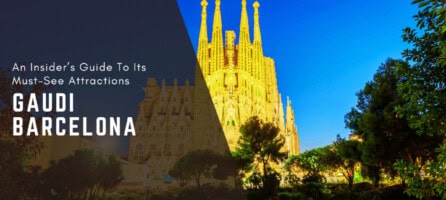
- Sagrada Familia : A large church that’s still being built, with tall towers reaching towards the sky.
Gaudí also liked to have fun. He often walked around town and looked at natural things like trees and waves, which inspired his designs. People say he had a special connection with nature.
In the end, understanding Gaudí is about enjoying how he mixed life and art in his buildings. He made us see magic in everyday things!
The Influence of Gaudí on Barcelona’s Architecture
Antoni Gaudí: A name as unique and unforgettable as the man who shaped Barcelona’s skyline. This Catalan architect was not just a builder; he was an artist whose canvas happened to be the cityscape of Barcelona.
“Gaudi’s architecture is the most original structure we have ever seen.”
– Pablo Picasso, 1930
His buildings are like sculptures – you don’t just look at them; you feel them with all your senses. They’re vibrant, alive…they’re so uniquely Gaudi that they’ve got their adjective: “Gaudiesque”. He had this knack for taking ordinary building materials – bricks, tiles, stone –and turning them into extraordinary works of art.
- Casa Batlló, one of his masterpieces, looks more like it’s been carved out of bone rather than built from bricks.
- Son opus magnum, Sagrada Familia, Plus de 100 ans plus tard, il est toujours en cours de construction !
It’s now taller than any other church in the world.
Now let’s wind back a century or two. Imagine walking down Passeig de Gràcia in 1900s Barcelona. You’re surrounded by uniform blocks of apartments when suddenly there it is – Casa Mila; La carrière de pierre.
It sticks out like a clown at a funeral but in the best possible way. Its undulating facade waves hello while its rooftop chimneys stand tall like sentinels guarding against everything boring and predictable. The influence this guy had on architecture, you’d think to yourself, ‘I mean seriously!’
This ladies and gentlemen, is “making an impact.”
Gaudí’s Masterpiece: An In-depth Look at Sagrada Familia
The Sagrada Familia is undeniably the shining gem of Barcelona, standing tall and proud amidst a bustling city. This marvelous basilica, designed by Antoni Gaudí, has been under construction since 1882.
With its towering spires that seem intent on poking holes in the sky and intricate facades telling biblical stories like juicy neighborhood gossip – it’s no wonder this unfinished beauty draws over 4.5 million visitors annually.
“There is no reason to regret that I cannot finish the church. I will grow old, but others will come after me.”
- Antoni Gaudí, 1926
The Nativity Façade, one of three grand entrances, is an explosion of complex organic shapes depicting scenes from Christ’s birth.
En attendant, The Passion Façade raconte une histoire plus sombre avec des sculptures austères qui font écho à une profonde souffrance.
Inside the basilica is where Gaudí’s genius truly shines. The stained glass windows paint sunlight into vibrant hues that wash across columns shaped like trees transforming stone into forest.
- Imaginez que vous pénétrez à l'intérieur au lever ou au coucher du soleil, lorsque la lumière danse autour de vous, créant des kaléidoscopes psychédéliques !
Mais n'oublions pas la crypte en contrebas qui abrite Gaudi lui-même. Quel que soit le coin où vous vous trouvez, there always seems to be something waiting to surprise you within Sagrada Familia – whether it’s staircases spiraling upwards like strands of DNA or gargoyles gazing down mischievously from dizzying heights.
Park Güell: A Testament to Gaudí’s Love for Nature

Parc Güell, nestled atop the city of Barcelona, is a whimsical tribute to nature by the famed architect Antoni Gaudí. In Park Güell, every nook and cranny echoes Gaudí’s admiration for Mother Nature. The serpentine benches that look like rainbows have kissed them are not just a feast for the eyes but also mimic the shape of a sea serpent.
But wait until you see his pièce de résistance: columns resembling tree trunks supporting an undulating roof mimicking leaf canopy. Gaudí’s love for nature didn’t stop at mere aesthetics. He incorporated sustainability long before it was trendy.
- Le système d'irrigation unique recueille les eaux de pluie,
- La lumière naturelle pénètre par des ouvertures judicieusement placées,
- Un système souterrain complexe permet de réguler la température.
Park Güell is a timeless testament to its creator’s genius – where urban meets organic so harmoniously; it almost feels magical.
Casa Batlló: Gaudí’s Tribute to the Sea

Casa Batlló is a special building in Barcelona designed by the famous Antoni Gaudí. It’s inspired by the sea. The outside of the building looks like sunlight reflecting off waves, and the windows look like seashells.
Inside, everything looks like it’s underwater:
- You feel like you’re underwater as you go up the stairs.
- Les tuiles changent de couleur, du bleu en bas aux couleurs du ciel en haut.
- Les vitraux ressemblent à la lumière du soleil dans l'eau.
- D'autres dessins ressemblent à des récifs coralliens ou à des varechs.
- Ils utilisent même des carapaces de tortues comme abat-jour pour apporter une touche amusante.
What makes Casa Batlló unique is how Gaudí combined nature with useful building features:
- Des lucarnes en forme d'écailles de tortue laissent entrer la lumière naturelle.
- Les puits de ventilation qui ressemblent à des algues marines maintiennent l'air frais.
These designs don’t just look good; they also make the building more eco-friendly and lively. Some people even say that you can hear faint sounds like whale songs inside Casa Batlló on quiet days. But that might just be our imagination.
Casa Milà (La Pedrera): Gaudí’s Break From Tradition

Casa Milà, often called La Pedrera, is a bold testament to Antoni Gaudí’s audacious departure from conventional architectural norms.
The structure breaks away from straight lines and right angles, choosing to flow in waves and curves instead. Every corner you turn in Casa Milà reveals another delightful surprise! From its undulating façade to its twisted iron balconies — every element rebels against tradition.
- Le toit avec ses cheminées surréalistes rappelle un paysage lunaire.
- The attic houses an exhibit dedicated to Gaudí’s innovative techniques.
- Chaque appartement présente des formes organiques uniques inspirées de la nature.
“The straight line belongs to men, the curved one to God.”
– Antoni Gaudí
Dubbed ‘the stone quarry’ or La Pedrera due to its rough-hewn appearance, this architectural marvel was initially ridiculed. But over time, critics had no choice but to admit that there’s something profoundly beautiful about breaking the mold (even literally!).
Aujourd'hui, il se dresse comme un Site du patrimoine mondial de l'UNESCO, L'exposition est un symbole emblématique de la façon dont le fait de s'éloigner de la tradition peut parfois nous conduire à une créativité extraordinaire.
Güell Palace: Showcasing Gaudí’s Early Brilliance

Gaudí’s design of Güell Palace in Barcelona is unique and stands out from the buildings around it. It’s beautiful and unique, and you can tell he put a lot of thought into every part of it. When you look outside the palace, you can’t help but stop and look at the fantastic details. The ironwork and the windows are beautiful, making the building look like something from another world.
If you go inside Güell Palace, you’ll see many amazing things:
- Le hall central : It’s shaped in a way that makes it sound exciting.
- Le toit-terrasse: Ce produit présente des formes amusantes qui ressemblent à des sculptures abstraites.
- L'écurie souterraine: Cette partie reste fraîche en été grâce à une circulation d'air intelligente.
Colonia Güell: Unveiling a Lesser-Known Gaudí Marvel

Colonia Güell, a hidden gem tucked away in the outskirts of Barcelona, is often overlooked by tourists drawn to Antoni Gaudí’s more famous works like the Sagrada Familia and Park Guell. But those willing to take a little detour will discover an enchanting site that offers a unique experience into the lesser-known side of Gaudí’s genius.
This picturesque industrial village turned UNESCO World Heritage Site houses one of his most remarkable yet under-appreciated masterpieces – the Colonia Güell Church.
Now, you may be asking yourself, “A church? Really?”
Well yes! But this is something other than your run-of-the-mill house of worship. It’s an architectural marvel showcasing Gaudi’s inventiveness at its best. The church was initially intended to serve as a beacon for workers’ spiritual needs in Count Eusebi de Güell’s textile colony.
Though unfinished (Gaudí had commitment issues with completing buildings), it stands proudly today, displaying its distinct style —a fusion of Gothic and Art Nouveau elements.
Laissez-moi vous brosser un tableau : L'intérieur est orné de mosaïques complexes fabriquées à partir de matériaux locaux, d'étonnants vitraux qui projettent une lumière colorée sur les murs en stuc blanc ; à l'extérieur, des cheminées fantaisistes ressemblant à des personnages de contes de fées parsèment les toits en terre cuite.
- The crypt boasts asymmetrical columns, which seem as though they’re grown right out of earth!
- You can also find here Gaudi’s trademark parabolic arches bending space towards higher celestial realms. This place gives new meaning to ‘heaven on Earth’.
Here comes my favorite part – there aren’t crowds of selfie-stick-wielding tourists.
So while everyone else flocks toward the bustling city center locations, why not escape off-the-beaten path and indulge in some peaceful contemplation amidst this architectural wonder? You never know what magic awaits when you dare take the road less traveled…or should I say ‘the path less cobbled’?
Modernism and Gaudí: Barcelona’s Artistic Evolution
Barcelona, a city celebrated for its stunning architecture, owes much of its artistic dynamism to the legendary Antoni Gaudí. His creative genius has left a mark so distinct that the city has become identified with his work. As you explore the streets of this beautiful Catalan capital, Gaudí’s masterpieces are never far from sight.
Modernism and Gaudí’s Unique Style

Gaudí didn’t merely adhere to the conventional rules of architecture; he expanded them. By embracing nature’s forms, he breathed life into bricks and mortar. The serpentine benches in Park Güell and the skeletal balconies of Casa Batlló are just a few examples of how he infused architecture with an organic, fluid quality.
Gaudí’s Influence on Modern Architecture
Gaudí’s unconventional use of curves and swirls was inspired by natural shapes, such as honeycombs and snail shells. In doing so, he made people reconsider the definition of “modern” in architecture. His style, though controversial at the time, reshaped architectural thinking.
- La Sagrada Familia: This unfinished masterpiece remains a testament to Gaudí’s inventive blend of Gothic and curvilinear Art Nouveau styles. Its complex design continues to leave visitors in awe.
- Le Parc Guell: Another example of Gaudí’s brilliance, this park is famous for its mosaic-covered terraces and unusual sculptures. It reflects his mastery over form and color.
Humor and Whimsy in Gaudí’s Works

Gaudí’s buildings don’t just impress with their innovation; they also entertain. Casa Milà (La Pedrera) is a great example, where the wavy stone facades and helmet-like chimneys almost expect a cartoon character to appear. His intricate tilework, imitating reptile scales, adds another layer of intrigue.
Un sens ludique de la réalité
Gaudí’s architecture invites visitors to let their imagination run wild. The experience of touring around Barcelona feels like stepping into the fantastical world of ‘Alice in Wonderland.’ His designs delight and puzzle, offering a whimsical escape from the ordinary.
Exploring the Gothic Quarter: Tracing Gaudí’s Footsteps

Walking around the Gothic Quarter, you can’t help but feel a sense of awe and fascination. This isn’t just any neighborhood; this is where Antoni Gaudí, the iconic Spanish architect, left his mark. Every cobblestone street seems to whisper tales of masterpieces crafted by Gaudí’s genius hands.
Now, let’s dive into some specifics.
La première étape de notre parcours est Gaudi’s first home. Here, he began to develop his distinctive style – an interesting blend of Gothic charm and modernist innovation. The building feels alive, almost like it’s breathing underneath its stone skin. Its quirky chimneys resemble sentinels keeping watch over the city below.
Prochaine étape La cathédrale de Barcelone; while not directly designed by Gaudí, its gothic influences significantly shaped his architectural ideology. As you gaze upon its towering spires and intricate facades, don’t be surprised if you find yourself lost in thought – contemplating how on earth humans managed such grandeur with mere chisels and hammers!

Last but certainly not least on our tour is arguably Gaudi’s most celebrated work – Sagrada Familia. Cette basilique colossale est en construction depuis plus de 130 ans ! Si la patience est une vertu, ces bâtisseurs doivent être des saints !
Explorer le quartier gothique wouldn’t be complete without observing these monumental structures, creative or otherwise, through your lens. So grab your camera (or sketchpad), put on your best walking shoes, and get ready to follow in the footsteps of one of history’s greatest architects.
Gaudí Beyond Barcelona: Expanding the Architectural Landscape
If you thought Gaudí was about Barcelona, brace yourself for a delightful surprise. His architectural genius has left its mark far beyond Catalonia’s capital city. From whimsical residences in Comillas to an impressive cathedral that dominates León’s skyline, Gaudí’s influence can be felt throughout Spain and even across international borders.
Now let’s take a detour from the well-trodden path of Park Güell and Casa Batlló.
España profunda, Nous y voilà !
In the picturesque town of Astorga stands his masterpiece – Bishop’s Palace.
- Le Capricho de Gaudi se trouve à quelques encablures, dans le nord de la Cantabrie.
- Crossing into France, Colonia Güell showcases Gaudí at his experimental best.
Each location carries its unique charm yet houses that signature touch: organic forms blended with innovative materials and techniques – truly “Gaudiesque.”
Tips for Touring Gaudí’s Barcelona: Maximizing Your Experience
Planifier votre itinéraire
Your adventure in Barcelona won’t be complete without a visit to the iconic works of Antoni Gaudí. But hold on! You can’t just barge into these masterpieces like you’re storming a castle. No, señor! La planification est essentielle.
Commencer par Parc Güell – mind-bending and colorful. It opens at 8 am; being an early bird helps you beat the crowd, but don’t forget your coffee!
Naviguer dans la ville
Next up is Casa Batlló, or as I like to call it, “the house that took acid,” thanks to its vibrant colors and surreal design. Getting around Barcelona might seem daunting, but it’s challenging yet fun. Use public transport for an authentic experience (plus points if you figure out bus routes before locals do).
- The L3 metro line will take you almost anywhere Gaudí.
Gagner du temps et de l'argent
Touring all day can make your wallet lighter than a helium balloon unless…you get yourself a ‘Barcelona Pass.’ This magic ticket gives access to over twenty attractions, including our friend Gaudi’s creations.
The lines outside these sites are longer than that novel you started during the lockdown and never finished (‘War and Peace,’ anyone?). So booking online saves time and keeps boredom at bay while waiting under Spain’s sizzling sun.


;?>/smartquizbuilder/includes/images/sqb-registration-img.jpg)


Is there a tour that will let two senior citizens in there eighty’s see Gaudi work we will be staying over two days after a cruise?