


Gaudi is arguably Barcelona’s most famous architect and a synonym of the architectural style of Catalan Modernism. He designed and developed several projects in the city and is also responsible for creating some of its most iconic landmarks, such as Park Güell, Casa Batlló, and the Sagrada Familia.
Aber es gibt noch viele andere von Gaudi entworfene Projekte in Barcelona, von denen Sie vielleicht noch nichts gehört haben.
Karte der Gaudi-Gebäude Barcelona
Browse through the interactive google map below or explore our list of the top Gaudi buildings in Barcelona. Don’t miss the chance to take a picture next to one of these architectural gems on your next visit.
1. Haus Vicens

Casa Vicens was Gaudi’s first project in 1883. Manuel Vicens I Montaner, a Girona businessman, commissioned Gaudi to design this project. Gaudi’s work on the building began in 1885, and the construction on the building finished in 1888. The building is an example of Gaudi’s early career before being commissioned for major projects including Park Güell or Sagrada Familia.
Gaudí’s style changed considerably from his early gothic work at Casa Vicens to a more modernist style for Park Güell and Casa Batlló, among other buildings built later in his career. The irregularly shaped building has a façade covered in dark red trencadís tiles, while the roof has red tiles and green lead.
2. Casa Milà (La Pedrera)
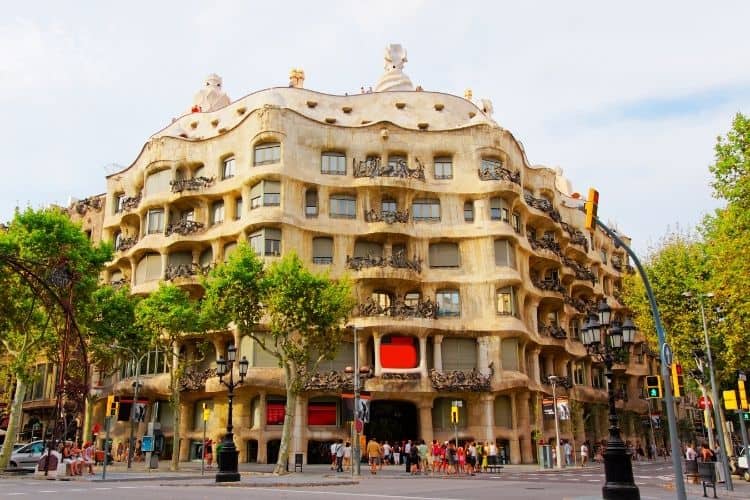
The first draft of the project was done on paper in 1902. The final design was not completed until 1910. Construction began on October 5 of that year, and on February 24, 1914, Gaudí took his last walk through the finished building.
He made the building of load-bearing brick with cut stone trim. Its façades are decorated with ceramic in various shades of orange and yellow, which were inspired by the Catalan flag. The roof covers are orange ceramic tiles shaped to look like large leaves; at either end are chimneys with tall pots that serve as ventilators for the kitchen stove inside that still operate today.
Stahlrahmen und Steinfassaden stützten das neunstöckige Gebäude und ermöglichten es Gaudi, frei mit Kurven zu experimentieren, einschließlich eines Dachgeschosses, das mit 270 verschiedenen Parabelbögen gefüllt war. Wie viele andere Werke Gaudis wurde auch dieses 1984 in die Liste des UNESCO-Weltkulturerbes aufgenommen. Die Anlage ist heute ein Museum, in dem Führungen für die Öffentlichkeit angeboten werden.
Casa Milá ist eines der extravagantesten Häuser, die man sich vorstellen kann. Erfahren Sie alles, was Sie für einen Besuch wissen müssen, und umgehen Sie die Warteschlange.
“Antoni Gaudí’s architecture is a poetic dream. It is a multifaceted mirror of life, a celebration of color and form, the song of an artist who reveled in the joy of his art.”
— George R. Collins
3. Park Guell

Gaudi’s design was not just avant-garde but he wanted to create a garden landscape that was wholly unique and innovative and intended to provide Barcelona with beauty, peace, drama, stability, and movement.
Park Güell mit seinen geschwungenen Stühlen in Form von Seeschlangen und den Stegen, die zu einem Aussichtspunkt mit einem herrlichen Panoramablick auf Barcelona führen, ist ein Muss für jeden Touristen. Gaudi verbrachte hier Jahrzehnte in seinem Haus, La Torre Rosa, während des letzten Teils seines Lebens. Touristen können das Innere des Hauses erkunden und einige seiner originalen Möbelentwürfe besichtigen.
4. Colonia Güell

When Gaudi’s long-time patron and businessman Eusebi Güell started the construction of Colonia Güell in 1898 on a suburban development for his employees, he commissioned Gaudi to build a neighborhood church.
By the time the Güell family abandoned the project in 1914, he had only finished the lower nave or crypt. However, even though the structure was only half constructed, it displayed Gaudi’s architectural ability and structural innovations.
5. La Sagrada Familia

Die Sagrada Familia ist wegen ihrer ungewöhnlichen Gestaltung und Größe die wichtigste Touristenattraktion in Barcelona. Mit dem Bau wurde 1882 begonnen, und die Fertigstellung ist für das Jahr 2026 geplant.
The architect’s goal was to create a perfect, pure form of God’s house on Earth as a temple dedicated to his faith. To achieve this, he used nature as his guide for its design and construction, even going so far as copying tree roots for building pillars.
The design of La Sagrada Familia includes three large basilica naves that form a cross shape with an immense central nave which reinforces the impression that it’s built on solid ground rather than suspended in the sky. Gaudi’s original sketches for the church continue to be displayed in the National Art Museum of Catalonia.
Das Hauptgebäude umfasst mehrere Türme, einen für jeden Apostel und drei über der Vierung des Querschiffs, die die Heilige Dreifaltigkeit darstellen, sowie einen großen zentralen Strebepfeiler, der einen Berg symbolisiert, aus dem ein Fluss fließt. Im Inneren finden die Besucher zahlreiche biblische Szenen, die durch Mosaikfiguren an Wänden und Decken dargestellt sind.

“Gaudí was a creator of dreams, a poet of construction, a painter of structures. His work united nature and architecture in a new and poetic language.”
— Salvador Dalí
6. Palau Güell

This private residence for Eusebi Güell, one of Gaudi’s first works, was a pinnacle of Catalan Art Nouveau architecture when it was completed in 1888, just in time for the Universal Exhibition that came to town that year.
Guests would arrive through carriages via a pair of gigantic wrought-iron gates inspired by seaweed and horsewhips and then continue through a succession of well-appointed rooms to a towering main parlor designed for entertaining. And inside, you’ll see a parabolic pyramid with a vast domed roof.
7. Finca Güell
In 1884, the Güell family commissioned Gaudi to design this building. Because of the architecture and unique design, it has become a major tourist spot. Gaudi has constructed the building in a rationalist style influenced by neo-Gothic and art nouveau.
Vertikale Linien und Terrassen mit asymmetrischen Öffnungen an den Fassaden, Außenwänden, Fenstern, Türrahmen und Bögen kennzeichnen die Finca Guell. Außerdem befinden sich an beiden Enden der Fassade zwei Türme, die einander aus entgegengesetzten Richtungen zugewandt sind, wodurch ein ähnliches Erscheinungsbild wie bei arabischen Moscheen oder Kathedralen entsteht.
The architect Antoni Gaudi gave his name to one of these towers as he admired Moorish architecture. The towers symbolized conquest but they eventually removed them to create more space for the family’s home on the upper floors (which it still is).
“Gaudí’s work is a reminder that architecture can be a form of poetry, a language of the soul.”
— Frank Gehry
8. Casa Batlló

In 1904, this refurbished mansion for Joseph Batlló was a landmark structure in the prestigious Passeig de Gracia neighborhood.
Gaudi’s outlandish design drew the attention of passersby, with a roof resembling the back of a dragon, a series of tile mosaics that appear to change color as you walk by, and columns and balconies resembling the discs of a spine. The architecture is a fever dream of design, with authenticity by an unconventional architect.
Casa Batlló ist ein unglaubliches Kunstwerk, das von der Meereswelt und der Natur inspiriert wurde. Erfahren Sie mehr über seine Geschichte, Tickets und mehr!
9. Haus Calvet

Casa Calvet is a building built by the Catalan architect Antoni Gaudí. He constructed it in 1906 for Pere Joan and Francesca Solé Turra, one of the famous Catalan textile families that migrated to France after the Spanischer Bürgerkrieg.
The house was an experimental work in which Gaudí experimented with new ideas that would later become characteristic of his mature style: structural sculptures integrated into walls, a large courtyard, interior decoration with natural details such as trees and plants.
“Gaudí’s buildings in Barcelona are not just architectural marvels; they are living works of art that continue to inspire and captivate.”
— Rafael Moneo
10. Kollegium der Teresianer
In 1899, Gaudi took over this institutional project, which consisted of a rectangular structure with classrooms, nuns’ quarters, and a beautiful wrought-iron gate. The ground floor facade is very sober and austere while the upper floors have elaborate decorations giving it a playful appearance.
Die großen Fenster sind mit gemeißelten Reliefs mit biblischen Szenen, Engeln und Arabesken geschmückt, während andere Fenster mit Glasmalereien versehen sind, die biblische Figuren oder Mythen aus der Antike darstellen.
Die Kollegium der Teresianer has very rich neo-gothic interior decoration thanks to Gaudí’s innovative brickwork, which allows its multiple floors to stand out from one another. The stained glass windows and the wooden furniture, including the pews and pulpits in the chapel, are particularly elaborate.
Außerdem wollte er das Gewicht der Wände reduzieren, indem er massive fliegende Strebepfeiler verwendete (die an einer dünnen Wand befestigt waren), die nur einem einzigen Zweck dienten: für Symmetrie zu sorgen.
11. Bellesguard
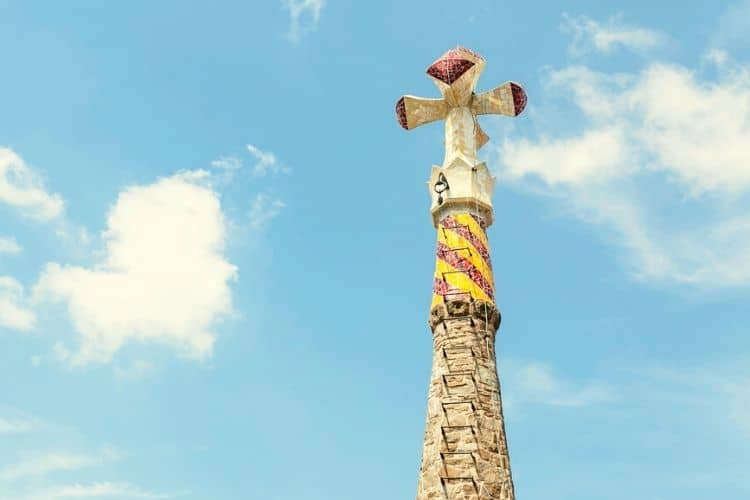
Built between 1900 and 1909 on the hilltop site where a royal summer residence once stood, Bellesguard (“beautiful view”) is a modernist stone manor house that serves as Gaudi’s version of a castle.
While it is crowned with gargoyles and a red-and-gold Catalan flag, the structure reflects Gaudi’s design in a very traditional, rectilinear manner.
Häufig gestellte Fragen (FAQs)


;?>/smartquizbuilder/includes/images/sqb-registration-img.jpg)


Anmerkung des Autors
Gaudi’s work provides the inspiration and goals of many travelers who visit Barcelona. His designs are pure and beautiful in their form, including the Bellesguard manor structure with a medieval theme. Gaudi has left a legacy of incredible architecture in the city.
His work has been preserved for future generations and has served as a testament to his genius. The Gaudi Barcelona map at the top of the page will help you locate some of Gaudi’s interesting buildings on your trip to Barcelona.
Hier finden Sie eine weitere Übersicht über die besten Gaudi-Gebäude in der Stadt sowie eine vollständige Biografie des Architekten, Besuchen Sie Barcelona Life.

Es maravilloso poder ver sus obras